The best note-taking methods
Note-taking is a valuable skill most of us learn as students and take with us into every meeting room, boardroom, and industry conference throughout our lives. The quality of your notes greatly affects your ability to understand and retain information. Naturally, finding the perfect note-taking method may seem like a lifelong and highly personal pursuit. But there are effective best practices — along with game-changing technologies like artificial intelligence (AI) — for note-taking that will help you retain information better.
The best way to take notes depends on your learning style, the type of content, and the amount of time you have. Ultimately, the right method for you is the one that will encourage you to learn and retain information as effectively and efficiently as possible.
In this guide, we’ll cover the best note-taking methods and how to apply them. We’ll also give you some tips for effective note-taking and how you can use tools to optimize your learning.
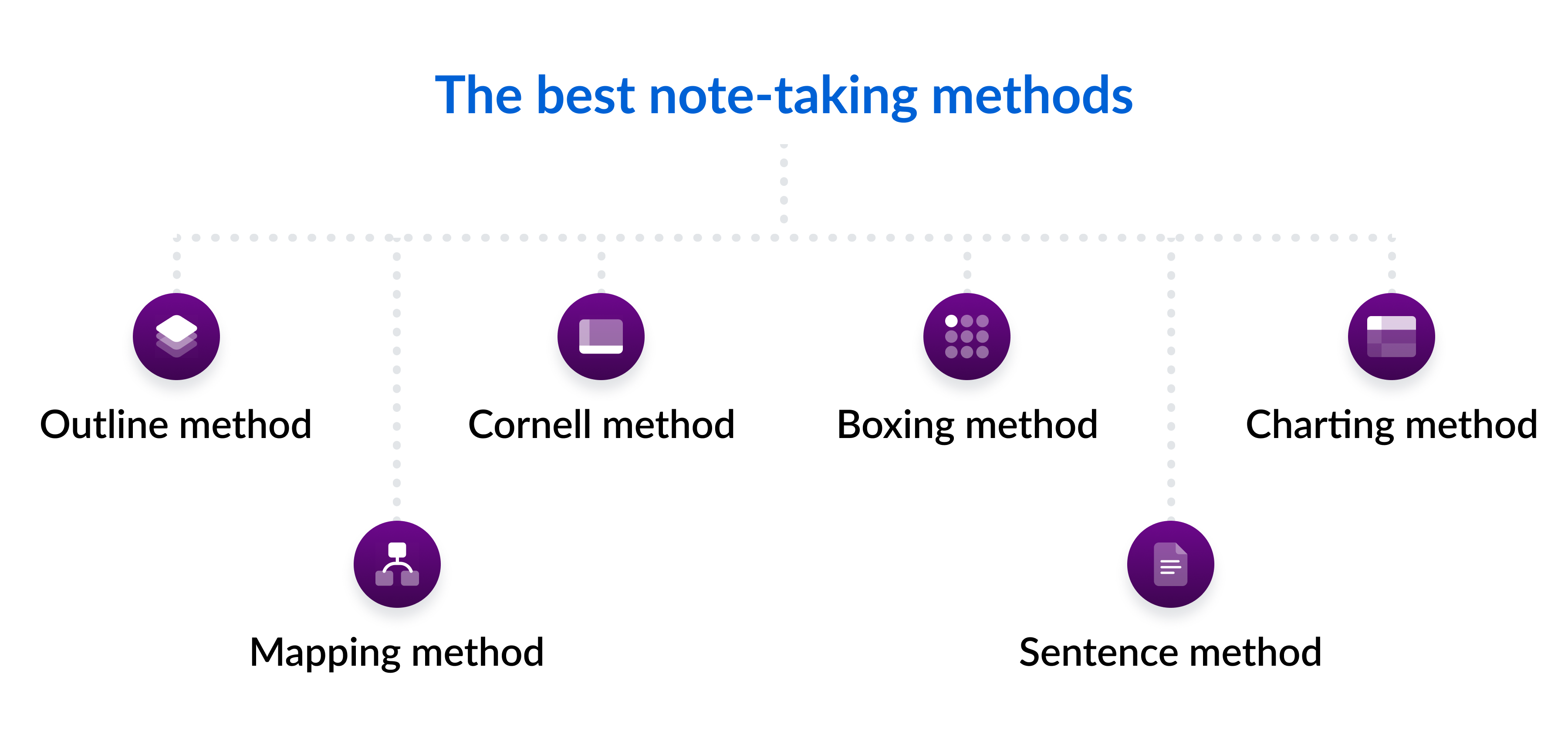
Here are six specific strategies for note-taking:
1. The outline note-taking method
The outline method of taking notes is one of the most intuitive and simplest options on this list. As the name suggests, this method turns notes into a hierarchy of information, providing a logical flow of content on the page and keeping it highly organized. With this strategy, you can take notes by hand or digitally and use headings and subheadings to create a clear structure, which is particularly effective for organizing complex or lengthy information.
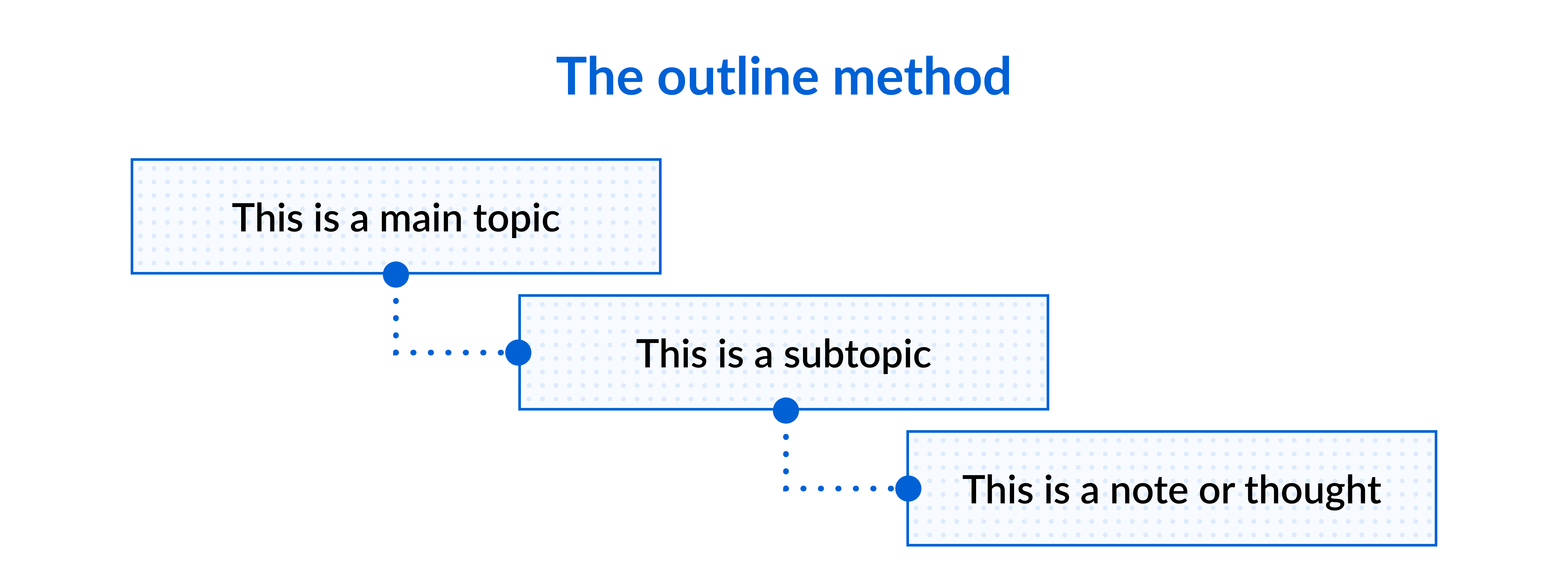
Here’s how to take notes using the outline method:
- Title the main topics on the far left of the page
- Use bullet points to add subtopics below each topic, indenting them toward the right
- Expand on each subtopic with supporting facts, notes, or questions, indented even further to the right
When using the outline method on paper, you must gauge how much space you need below each subtopic heading for all your notes. With a digital note-taking app, you can always create more or less space as you go. With practice, you can become highly efficient at taking notes this way while keeping them neat and professional.
Pros
The advantages of the outline note-taking method include:
- Visually clean and organized notes
- Naturally drawing connections between topics
- Easily converting outlined notes into summaries or study questions for easier review
Because of how simple and clean the outline method is, it can help people save time when reviewing and learning later.
Cons
The disadvantages of the outline method of note-taking include:
- Complexity when trying to add graphs and diagrams
- Requirements that content be highly structured
- Lengthier notes, as this method can lead to more detailed sections
Since the outline method requires you to leave space for subtopic notes, you may become more focused on filling up the space rather than narrowing down the most important content.
2. The Cornell note-taking method
The Cornell method of note-taking was designed for students by Cornell University professor Walter Pauk. Similar to the outline method, Cornell encourages note-takers to keep clean, organized, and condensed notes. It’s an especially useful method for revisiting your notes, reviewing what you learned, and consolidating your new knowledge.
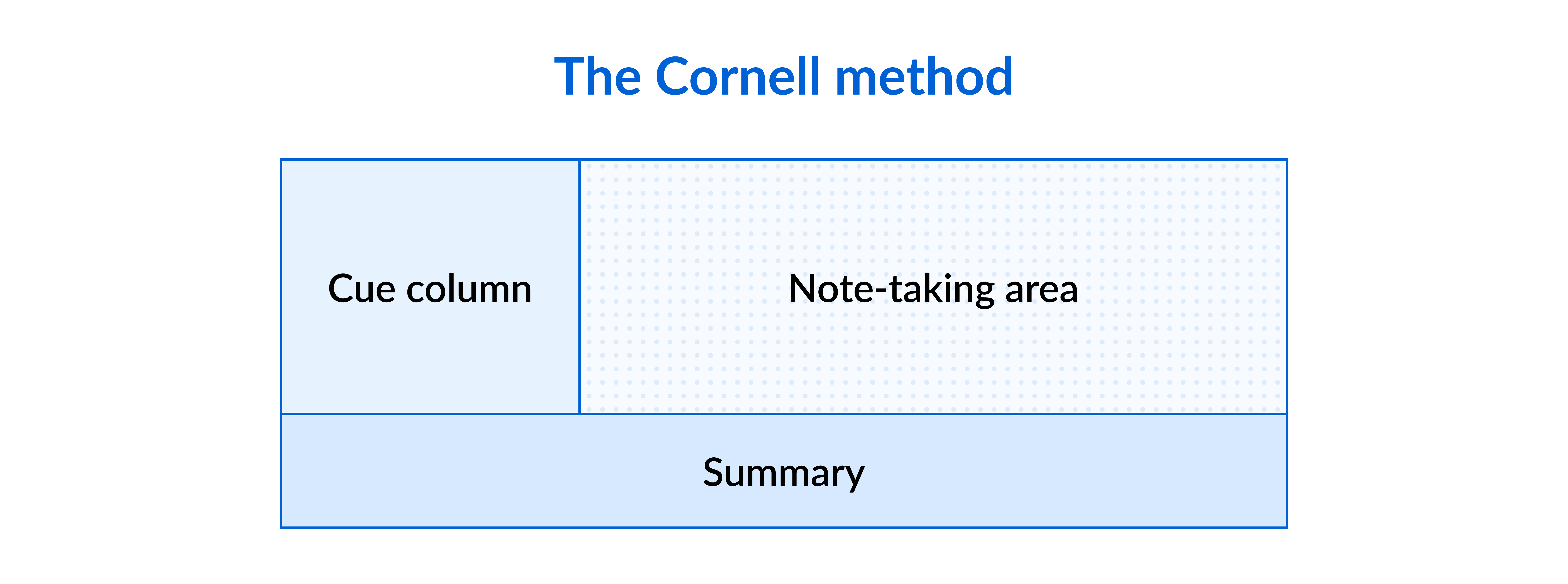 Here’s how to take Cornell notes:
- Divide your page into two equal vertical columns
- Leave the lower one-third to one-quarter of the page divided from the columns, creating an upside-down T on the page
- Use the left column to cue keywords or ideas and the right side for expanded notes
- Summarize the material in the space at the bottom of the page
While the Cornell method is well-known for being handwritten, it can also be done with digital note-taking tools. Cornell is also an effective note-taking approach for self-testing, which is a proven way to learn and retain new information.
Pros
The advantages of the Cornell method include:
- Encouraging people to review and summarize information for better retention
- Keeping notes organized and easy to review
- Helping note-takers learn the most important ideas and terms
With a heavy focus on summarizing information, the Cornell method helps people save time when reviewing in the future.
Cons
Let’s explore the disadvantages of the Cornell method:
- Not suitable for sessions with heavy terminology and statistics
- Requires summarizing information immediately following the lecture, meeting, or conference
- Contingent on preparing notes pages before the lecture
The Cornell method is typically geared toward abstract subjects with central ideas rather than facts and data.
3. The boxing method of note-taking
The boxing method of note-taking is geared toward those who are visual-dominant learners. This form of note-taking consists of creating boxes or outlines to represent different sections or ideas within your notes.
Similar to mind mapping, boxed notes allow people to see how ideas are connected and flow from each other. You can take boxing notes by hand or digitally with the help of visual collaboration tools like a lasso tool, which allows you to easily group items together.
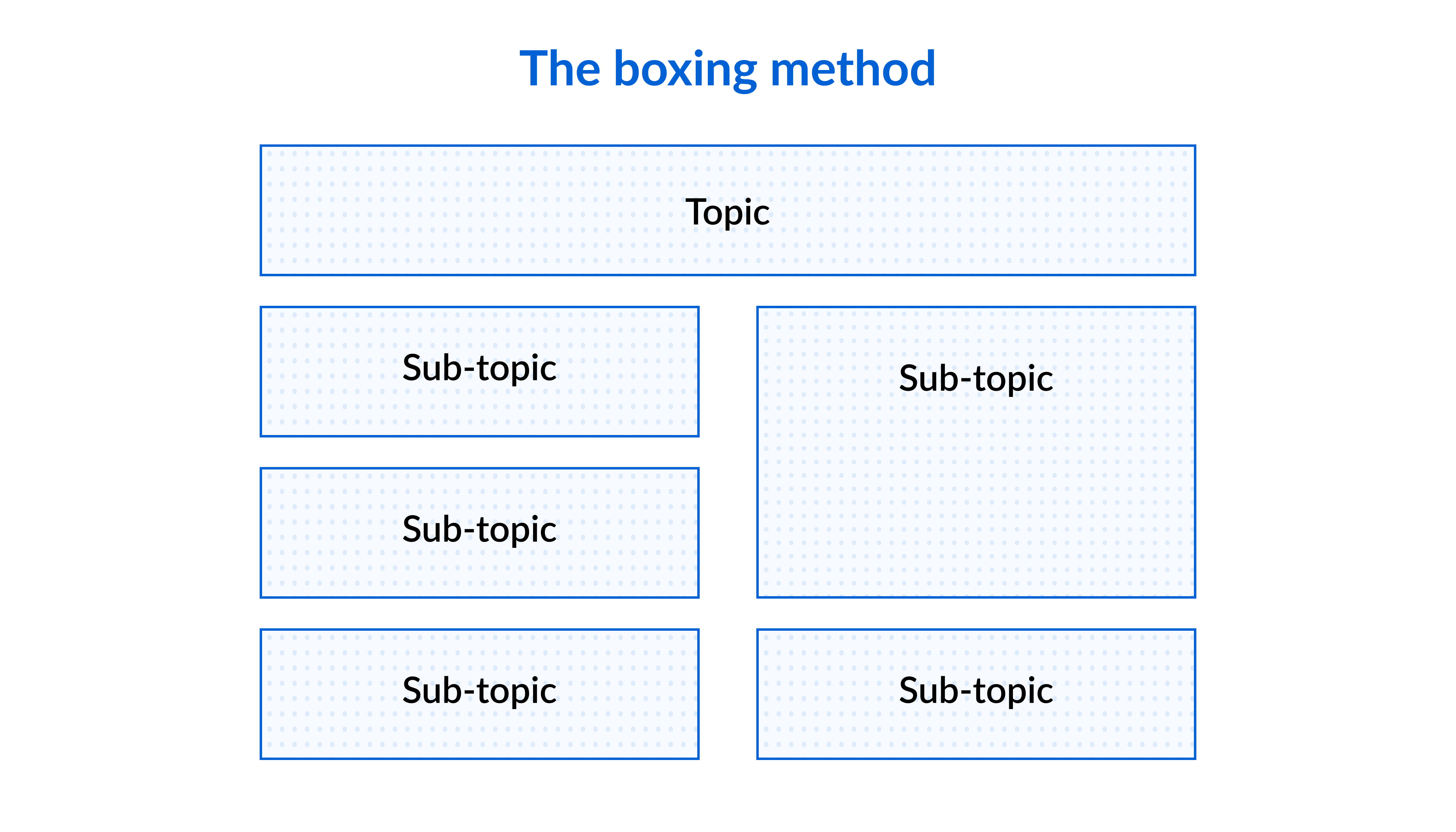
The boxing method uses the following steps:
- Divide the page into two columns
- Add topic headers for each core idea and expand with key points directly below the topic
- After completing notes for each header, draw a box around the entire note section and header
The final page will appear as multiple different-sized boxes neatly containing each core topic and its notes. From there, you can either mind map by drawing connecting arrows between ideas or leave the boxes separate. By grouping topics in clusters, learners can take deeper dives into each subtopic while still understanding how ideas are related.
Pros
The advantages of the boxing method of note-taking include:
- Encouraging people to rewrite notes into boxes, which reinforces retention
- Helping improve recall with visual representations of ideas and how they connect
- Promoting clarity and brevity due to the need to condense notes into boxes
The boxing method is suitable for people who like to prioritize the aesthetic look of their notes and enjoy being creative.
Cons
Here are the disadvantages of the boxing method:
- Unsuitable for those who want a quick and hierarchical solution
- Requires already having an understanding of how ideas are connected
- May distract learners with how notes look rather than focusing on the content itself
The boxing method doesn’t make sense for lectures or meetings that don’t cover multiple core ideas or topics that can’t be easily assigned to specific boxes.
4. The charting note-taking method
The charting method of note-taking is one the most effective for fact- and data-heavy content. It involves creating a diagram or chart to represent the relationships between different concepts or ideas. When the content is highly structured and uniform, the charting method provides an efficient way to keep up with the material.
Because this method is based on facts and keywords, it’s a beneficial way to memorize information and test yourself with recall exercises. It’s less ideal for abstract concepts and ideas.
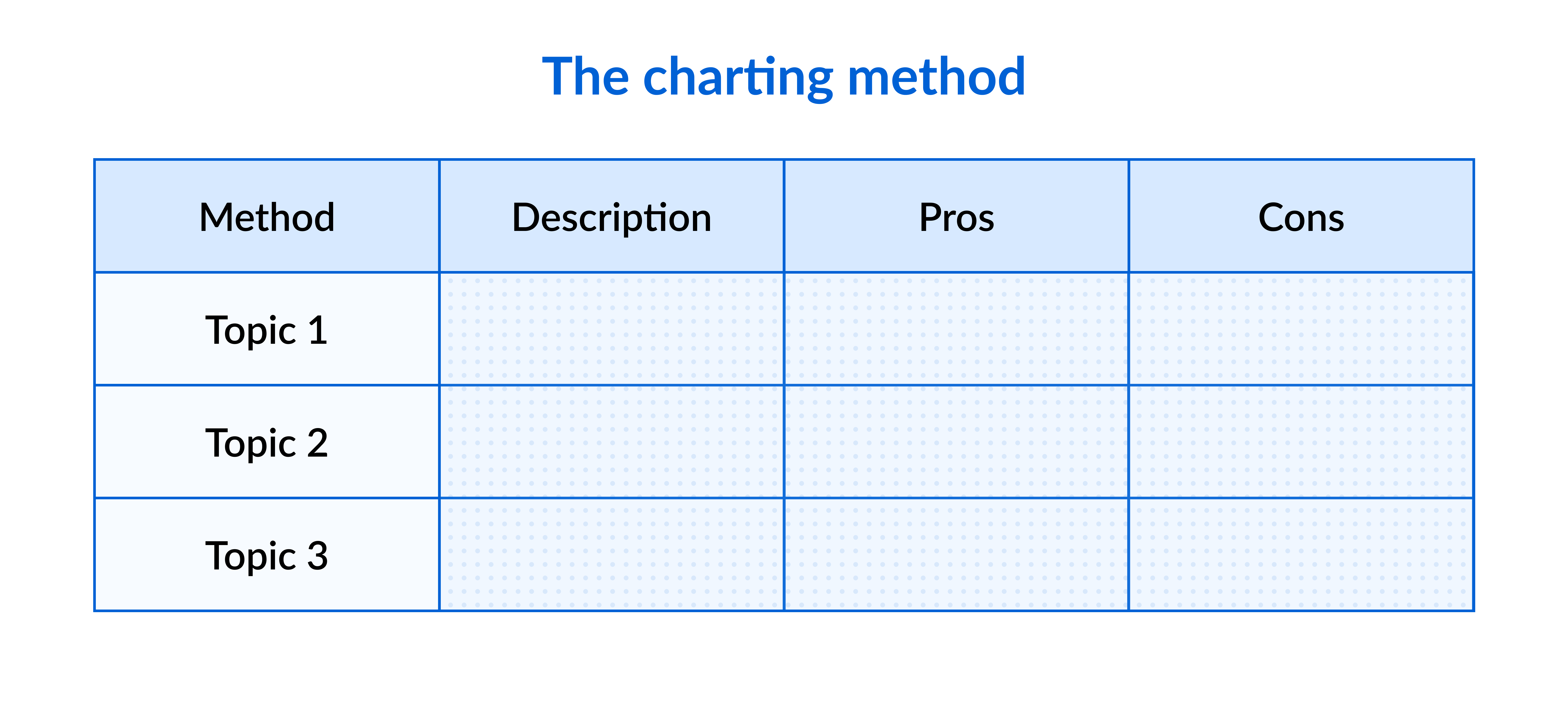 To follow the charting method, take the following steps:
- Determine what topics the lecture will cover
- Divide the page into multiple columns, each with its own relevant keyword
- Record relevant notes under each applicable keyword
You can take charting notes by hand if you have a ruler or another way to divide up your page neatly. Or you can take charting notes digitally using a document management system that integrates with your text editor or even a spreadsheet application.
Pros
The advantages of the charting method of note-taking include:
- Relevant for content that requires memorization and keeping track of facts and statistics
- Useful for summarizing and reviewing content in preparation for exams
- Effective for promoting concise, clean, and organized notes
Charting is one of the best note-taking methods for comparing and contrasting similar terms or ideas.
Cons
The disadvantages of the charting method include:
- Incompatibility with sessions that don’t provide the structure beforehand
- Necessity of spending time preparing your note pages in advance
- Unsuitability for use during lectures or meetings with heavy discussions
If it’s difficult to categorize the content, then it will be challenging to apply the charting method.
5. The mapping method for note-taking
Mapping is one of the favorite note-taking strategies in both the education and business worlds. This visual approach involves creating a diagram or map to represent the relationships between concepts or ideas.
When learning or covering complex, abstract information, mapping can help eliminate the fuzziness around highly involved topics. While visual learners tend to prefer this method, it’s useful for anyone trying to connect big ideas and themes and discover how they flow from each other.
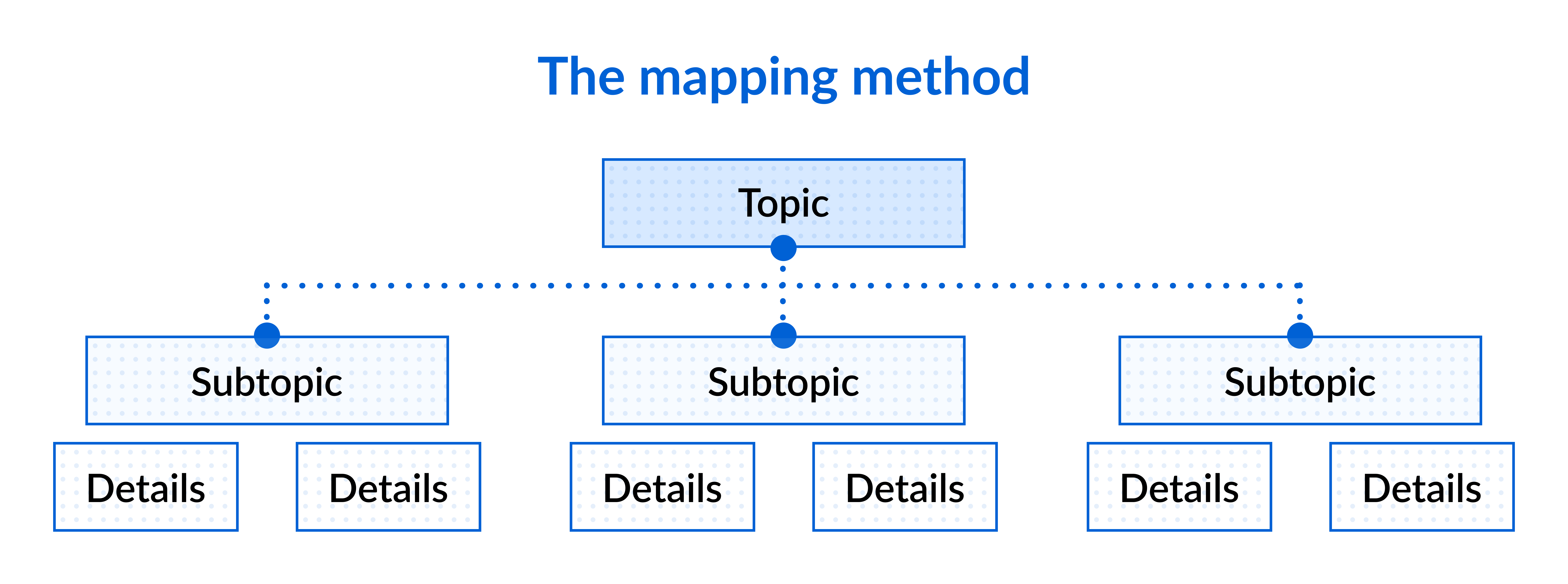 Here’s how you can put the mapping method of note-taking to use:
- Write the main topic at the top of the page
- Create one branch for each subtopic, stemming from the topic before it
- Continue dividing the subtopics downward and outward on the page
- Add relevant notes directly under each subtopic
The final result should be a web or hierarchy of information, similar to a flow chart. Mapping allows you to be creative, using colors or symbols to represent how ideas compare or relate. You can map notes by hand or digitally.
Pros
The advantages of the mapping method of note-taking include:
- Effective review and study through reorganizing original notes into a map
- Deep learning and understanding of complex topics
- Visual learning and memory recall
The mapping method is visually appealing and a great way to rewrite your original notes during a study, meeting, or review session.
Cons
The mapping method also has some limitations:
- Space is constrained, requiring careful placement to ensure all notes fit within a single map
- Notes need frequent revision to prevent confusion
- Mapping takes up time if relationships between ideas aren’t clear to the note-taker
The mapping method is not always ideal for taking your first round of notes since it can be difficult to gauge how much space you will need.
6. The sentence method of note-taking
The sentence method of note-taking is the simplest and least structured strategy. It involves writing each idea as a complete sentence. When the content itself is not outlined, then the sentence method can help give your notes a slight structure that the topic is missing.
The sentence method is particularly useful for fast-paced conferences, workshops, or meetings that cover a lot of content. It works for either handwritten or digital notes.
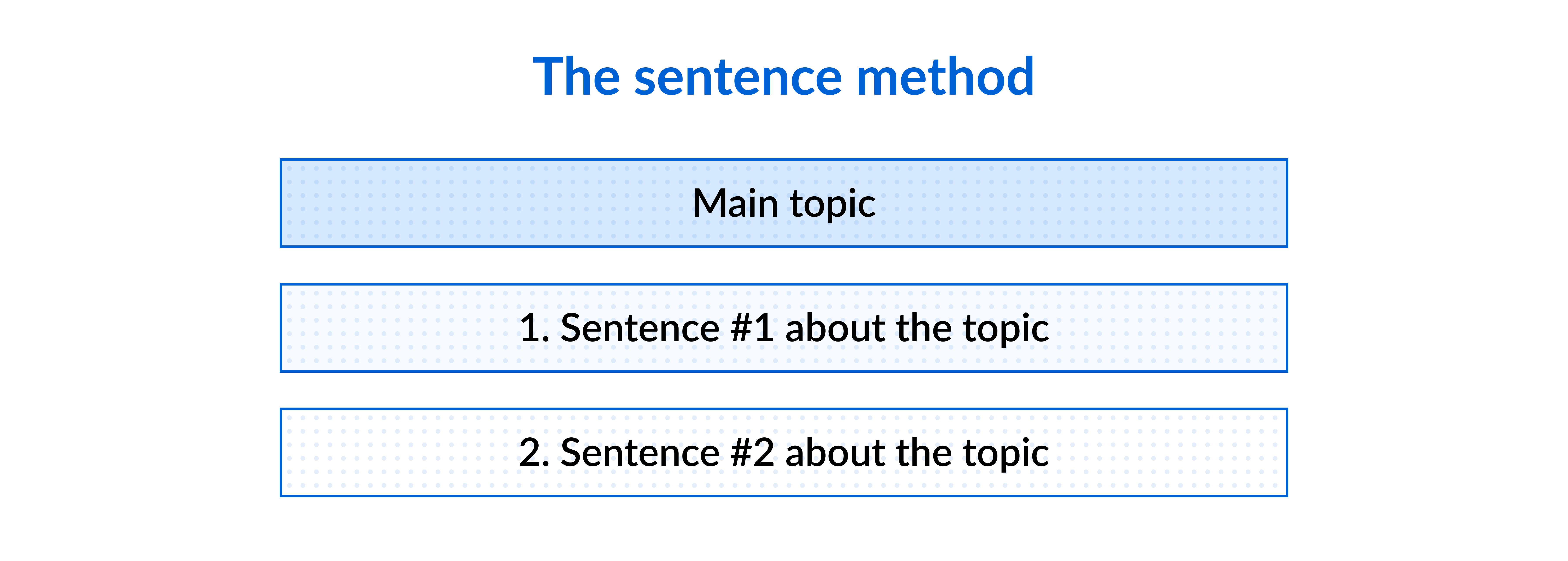 To practice the sentence method, use lined paper and follow these steps:
- Record content, such as terms, facts, or ideas in sentences
- Move to the next line for each new point
- Number each new sentence as you progress through the content
People who have nothing prepared ahead of a lecture or session tend to jot down notes in sentence form, making this one of the best methods for taking notes, as it's natural and straightforward.
Pros
The advantages of the sentence method include:
- Recording information that stands out in an easy way
- Keeping track of content in chronological order
- Converting notes into any other method
The sentence method is a spontaneous way to keep notes without the need for advanced preparation.
Cons
The disadvantages of the sentence method include:
- Lack of the visual structure that many people need
- Difficulty in reviewing later if the material appears disjointed
- Incompatibility with content with graphs and charts
The sentence method is often a last resort when it’s impossible to prepare for a meeting or lecture and when the content is too all-over-the-place to slot into any of the above methods.
Handwritten vs. digital notes
Along with choosing your preferred note-taking strategy, there’s another key decision: the choice between writing notes by hand or capturing them digitally. For some people, the debate between handwritten and digital notes is contentious, with some learners having a clear preference for one method over another.
 The choice between handwritten vs. digital notes comes down to what will yield the best results for you. Whether one approach is cleaner or faster is only part of the equation. The priority should be choosing the method that will actually help you learn and retain information better, with the ability to easily review.
Handwritten notes
There are some factors to consider when handwriting notes. A study by the Norwegian University of Science and Technology analyzed the brain activity of young adults and 12-year-old children and found that handwriting with a digital pen activated brain regions associated with memory and learning more effectively than typewriting. It is also easier to be distracted by other applications when taking notes on a device. However, handwriting notes may prove too time-consuming for fast-paced work or study environments.
Digital notes
Compared to handwritten versions, digital notes are a fast and clean method for efficient note-taking. They allow you to add graphs, charts, and clipped images, while some options offer AI tools so you can write a summary in seconds to streamline your learning process. However, digital note-taking may encourage transcription rather than deep learning, as many students focus on typing every word rather than actually paying attention to the content.
There is also a popular hybrid approach. You can take initial notes by hand and then transcribe them to a digital version, cleaning them up in the process. This allows you to convert your original handwritten notes into the best method for the final version.
Tips for effective note-taking
Regardless of your chosen strategy, some general note-taking tips apply to everyone.
The following best practices can help you take your learning to the next level.
Know the content
One of the main takeaways from learning about the different note-taking practices should be that the relationship between the method and the type of content is critical. Certain methods are clearly more suitable for some types of content, while others are not conducive to certain events. For instance, you don’t necessarily want to spend an entire in-person meeting typing notes on your mobile phone.
Content is typically either structured or unstructured, meaning you may or may not have a clear outline to follow and build your notes around. In addition to being outlined or not, content can also be conceptual or fact-based. These distinctions will help you choose whether you need a fluid or structured note-taking method.
Experiment with note-taking methods
Your ultimate goal should be to find the most applicable method for the type of content you’re dealing with. To discover the best one, you may need to experiment with different styles. By comparing and contrasting the pros and cons of each method, you’ll eventually find how to take effective notes your way.
Keep in mind that it’s also possible to combine multiple methods of taking notes. For instance, you can have one page for terms and facts and another page for mapping ideas and concepts. Applying different ideas helps you come up with a custom system that you can refine over time.
Review notes later
Effective learning is more than just taking notes. What you do with your notes after a learning session is crucial to move your newly acquired knowledge from the surface to the deeper parts of your memory.
Things you can do later:
- Schedule a block of time to review your notes
- Create a summary or overview of your notes
- Test yourself on the new material
- Write down questions you have
- Highlight information that’s still unclear
By taking the time to follow up and review your notes later on, you increase your chances of performing well and retaining the information.
Ask questions
Effective note-taking isn’t sufficient for learning and retaining information. You must also engage with the content and test yourself, finding your knowledge gaps and filling them with missing information. As you take notes, write down questions to ask later. Asking questions is critical in getting clear on core topics and solidifying your knowledge.
Additionally, spending time with instructors, lecturers, and subject-matter experts helps you deepen your knowledge in areas of genuine interest to you. By asking questions, you have the opportunity to assess your own thinking. You’ll also identify where you can improve your grasp of the material.
Use AI for note-taking
According to Asana’s State of AI at Work, on average, workers take advantage of AI for five different use cases. AI content generation is at the top of this list, which means teams are likely to employ this technology to organize and categorize notes instantly, making them easier to find and reference later.
Need inspiration on how to use AI for note-taking? Explore other ideas.
- AI summarization: LLMs can transform lengthy meeting transcriptions into clear briefs, highlighting the most critical information and saving you time on review
- AI content discovery: Searching through your notes becomes faster and more intuitive with AI, as the technology understands context and relevance, providing more accurate results
- Content retrieval: When integrated with methodologies like retrieval-augmented generation (RAG), AI tools can locate files or specific key points from your notes, ensuring that important details don’t get overlooked
Explore the top use cases of enterprise AI adoption in 2024.
Leverage Box as your note-taking platform
Whether you take digital notes exclusively or like to transfer your handwritten thoughts to digital later on, you’ll need to organize your material in a secure and user-friendly way. That’s where Box comes in.
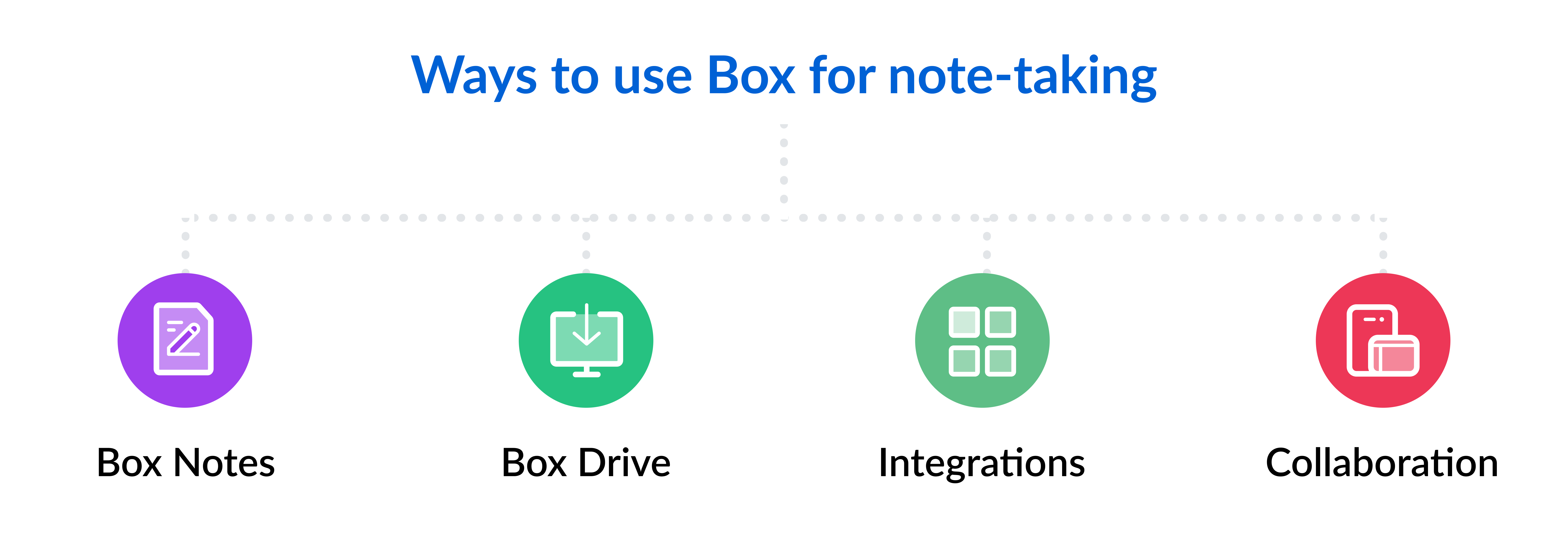 Check out the top ways Box can help with your note-taking needs.
Box Notes
Let Box Notes be your go-to source for high-quality, user-friendly note-taking. Write down documents quickly and efficiently in real time, or transcribe your notes the way you want them to look. With Box, you can create convenient templates to use for each course or meeting, saving you time.
You can also embed videos and other media within a Note, add comments for collaborative note-taking, and integrate Box AI to generate text or summarize extensive documents, ebooks, or presentations in a few seconds.
Integrations
Optimize your annotations with Box Integrations. With over 1,500 different applications available, you can connect your favorite productivity, studying, or editing programs to Box.
Rather than re-inventing your current note-taking system, seamlessly integrate it into your Box workspace for more efficient learning.
Collaboration
Streamline your study sessions or group projects with Box collaboration. Using Box Notes or any other file type, work together with your team members on a single project in real time.
Use Box as a central workspace to edit, review, and share notes. Assign tasks and add comments to make sure everyone is on the same page.
Maximize your note-taking efforts with Box
Intelligent Content Management can help you learn smarter, not harder. By storing all your notes in a central digital hub, you’ll always have the material you need at your fingertips.
Explore all the ways that Box can help you succeed in your learning practices. Contact us today.
While we maintain our steadfast commitment to offering products and services with best-in-class privacy, security, and compliance, the information provided in this blog post is not intended to constitute legal advice. We strongly encourage prospective and current customers to perform their own due diligence when assessing compliance with applicable laws.